Raised beds look huge in spring.
At least mine do.
There is all this beautiful empty soil, the seedlings are tiny, and suddenly I am convinced I can fit tomatoes, zucchini, beans, lettuce, basil and probably three more things into one bed.
Then July arrives.
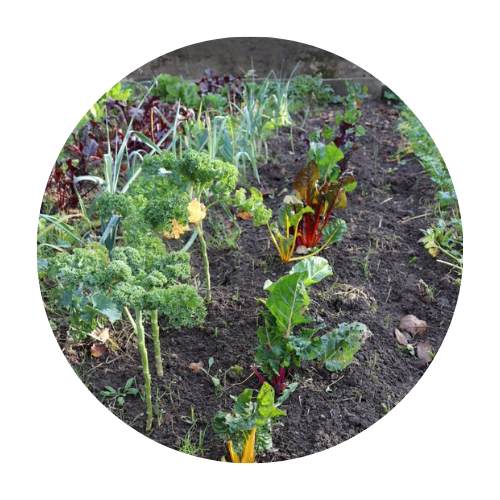
And the raised bed has basically disappeared under leaves.
That is why I think a raised bed companion planting layout needs a slightly different approach than a normal garden area.
There is less room to make mistakes.
And it is very easy to overplant.
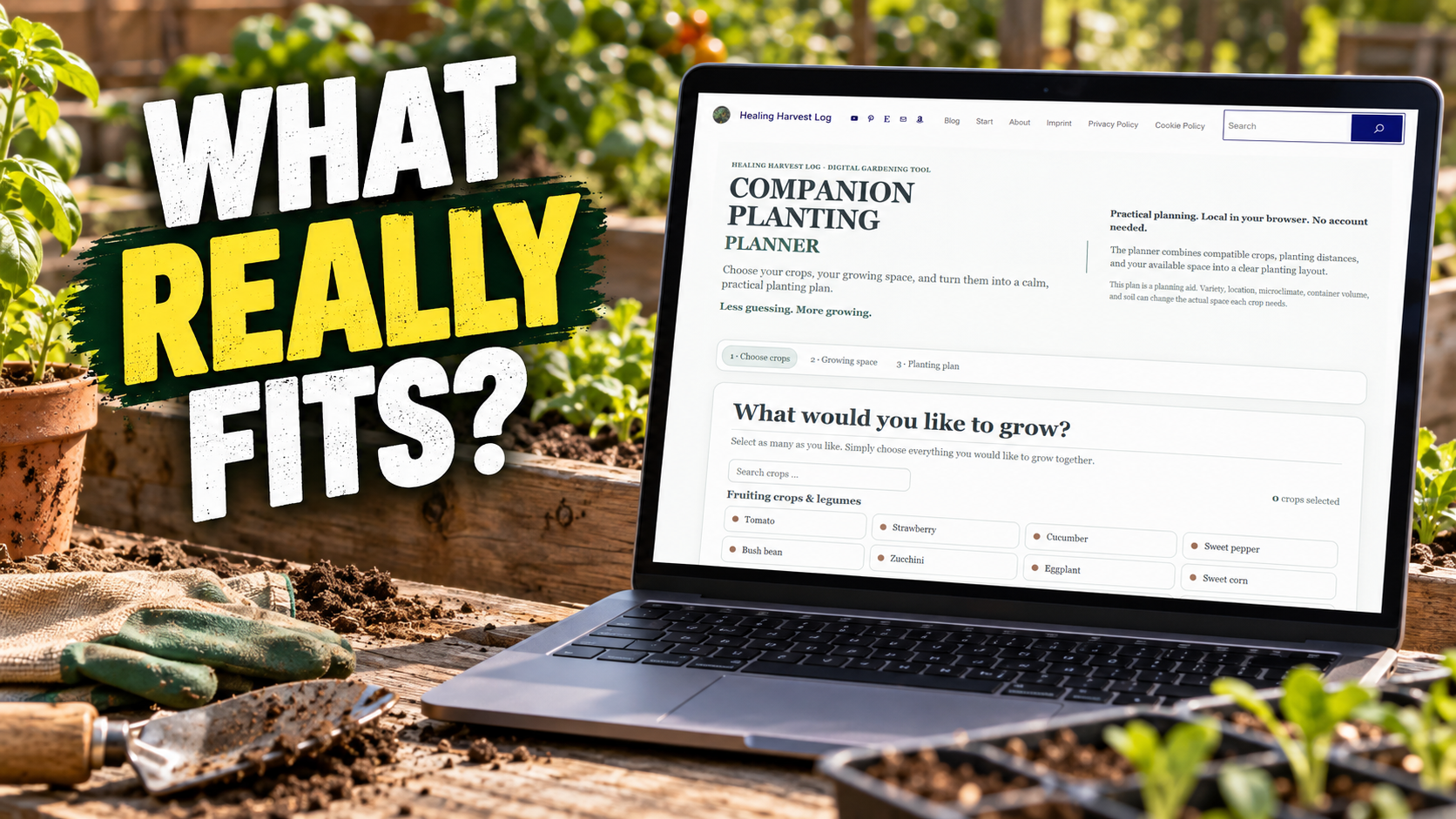
That is also why I added a separate Raised Bed mode to my planner.
Create your raised bed layout with my free Interactive Companion Planting Planner.
You enter the dimensions of your raised bed, choose how many beds you have, select the crops you want to grow, and the planner creates a simple row-by-row layout.
Why Raised Beds Are So Easy to Overplant
The problem starts with tiny plants.
A young tomato looks as if it needs almost no room.
A zucchini plant looks innocent.
Beans take up hardly any space when they first go in.
So the raised bed still looks empty.
And that empty soil is very tempting.
I know the feeling of looking at one little gap and thinking:
There is definately room for one more plant.
Usually there is not.
A few weeks later, the leaves begin touching.
Then overlapping.
Then one plant quietly starts living in another plant’s space.
So now I try to plan for the plant I will have later in the season, not the one I am holding in my hand.
Measure the Raised Bed First
Before choosing combinations, I start with the actual bed.
Length.
Width.
Number of beds.
That is enough to begin.
I used to make rough plans in a notebook, but I was always changing them.
Then the page became a mess.
With the planner I just enter the dimensions.
If I have two or three raised beds, I can add those too.
The growing space becomes the starting point instead of the plant list.
That small change makes planning much easier for me.
Choose What You Actually Want to Grow
I still start with the same question I use for my normal garden:
What do I actually want to eat?
It is surprisingly easy to build a raised bed around companion planting advice and forget that I never really wanted some of those plants in the first place.
So I choose the crops first.
- Tomatoes.
- Peppers.
- Carrots.
- Lettuce.
- Beans.
- Herbs.
Whatever I really want that year.
Then I let the planner help me organise them.
The goal is not to squeeze the maximum number of species into one bed.
It is to create a bed that I can still understand in summer.
How Many Crops Can Really Share One Raised Bed?
There is no single number.
A bed with lettuce, radishes and herbs behaves very differently from one with tomatoes and zucchini.
The size of the plants matters more than the number of names on the list.
One big zucchini can use more space than several smaller crops together.
A tomato can grow far beyond the little area I imagined for it in May.
That is why I prefer to think in rows.
It gives the plants some structure.
And it gives me a chance to notice when I am trying to put too much into one bed.



One Crop Per Row Keeps Things Simple
For my raised bed planner, I use one crop per row.
That does not mean it is the only way to companion garden.
It is just the way I find easiest.
- One row of tomatoes.
- One row of basil.
- One row of carrots.
The crops are still growing as neighbours, but I can see clearly where each one belongs.
That matters to me.
Raised beds already become dense very quickly.
I do not need the plan itself to be confusing too.
Think About Tall Plants Before You Plant
Tomatoes, climbing beans and cucumbers do not stay small.
If I put them in the wrong place, they can change the whole bed.
They can shade smaller crops.
They can block access.
And suddenly I am trying to reach lettuce through a tomato jungle.
So now I think about height much earlier.
Where will the tallest plants be?
Where will the trellis go?
Will I still be able to reach the middle of the bed?
This sounds very basic.
But I have ignored it more then once.
A 4×8 Raised Bed Can Fill Up Fast
The classic 4×8 raised bed looks generous when it is empty.
And yes, you can grow a lot in it.
But that does not mean everything belongs in it at once.
The mistake I used to make was planning each crop separately.
I would think:
- There is room for tomatoes.
- There is room for beans.
- There is room for lettuce.
- There is room for zucchini.
All of those statements could be true on their own.
Together?
Not always.
The finished size of the plants matters.
That is exactly why I like seeing the crops laid out before I plant anything.
The plan gives me a chance to realise that I may need a second bed.
Or fewer crops.
Or maybe one less zucchini.
Usually one less zucchini.
Planning More Than One Raised Bed
This is where the planner becomes especially useful for me.
If I have several beds, I do not want to plan each one completely seperately.
I want to see the whole picture.
- Which crops could go into Bed 1?
- What belongs in Bed 2?
- Where are the tall plants?
- Where do I still have space?
The planner lets me enter the number of raised beds and their dimensions.
Then it organises the crops into rows.
It is still my garden.
I still choose what goes in.
The tool just helps me stop moving plant names around on paper for half an hour.
Raised Bed Companion Planting Is Still About Space
I think this is the part that gets lost when we talk about companion planting.
Two plants can be compatible and still need enough room.
Compatibility does not make the plants smaller.
It does not remove their roots.
And it does not stop one giant leaf from covering another plant.
So I use companion planting as part of the plan.
Not instead of the plan.
That distinction has made raised bed gardening much calmer for me.
Turn Your Raised Bed Measurements Into a Plan
If you already know what you want to grow, you can create your own layout in a few minutes.
Choose Raised Bed.
Enter the length and width.
Add the number of beds.
Select your vegetables, herbs and flowers.
Then let the planner create a simple row-by-row layout.
Open the free Interactive Companion Planting Planner and plan your raised beds.
You can print the plan or save it as a PDF.
I like having mine nearby when I plant.
Because once I am outside, I always think I will remember everything.
I never do.
The Raised Bed Will Still Surprise You
Even with a plan, the garden will change.
One plant will grow bigger than expected.
Another one will stay smaller.
A corner may get more shade.
A tomato may decide to take over half the bed.
That is fine.
The planner gives me a starting point.
Then I adjust.
That is still the part I enjoy most.
A little planning.
A lot of watching.
And usually some improvising.
Raised Bed Companion Planting Layout FAQ
What is the easiest way to plan a raised bed companion planting layout?
Start with the exact dimensions of your raised bed and the crops you actually want to grow. Then organise them into clear rows while keeping the mature size of each crop in mind.
How many vegetables can I grow in a 4×8 raised bed?
It depends on the crops. Several small vegetables can fit where one large zucchini or tomato may need much more room. I prefer planning around mature plant size rather than simply counting plants.
Can I plant different vegetables in the same raised bed?
Yes. That is the whole idea of companion gardening in a raised bed. I just prefer keeping the layout clear with one crop per row.
Should companion plants be mixed together?
They can be, but they do not have to be. Neighbouring rows are often much easier to plan, water and harvest.
Can I plan several raised beds at once?
Yes. In Raised Bed mode, you can enter the dimensions and number of beds you want to include in the planting plan.