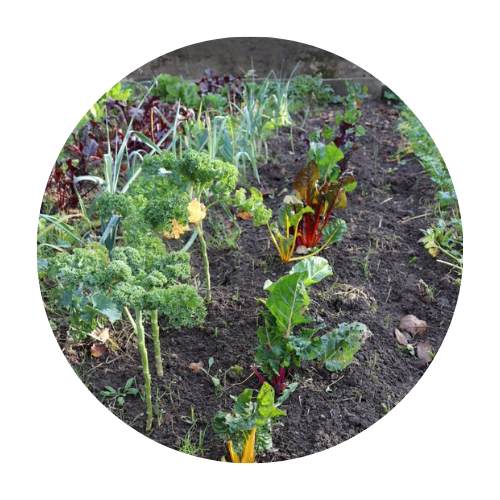

I usually know what I want to grow long before I know where I am going to put it.
Tomatoes are always on the list. Beans too. Carrots, cucumbers, herbs. And somehow there is always one seed packet too much sitting on the kitchen table.
Then I walk outside and look at the actual garden.
And that is usually the moment when I think:
Okay… where does all of this go?
For me, that is the practical side of companion gardening.
It is useful to know which plants can grow well near each other. But I still need a companion planting vegetable garden layout that fits the space I really have.
That is why I added a Garden mode to my planner.
Create your garden layout with my free Interactive Companion Planting Planner.
You choose the crops, add your garden dimensions and number of beds, and the planner turns those choices into a simple row-by-row plan.
Start With the Garden You Actually Have
Before I think about plant combinations, I measure the garden.
Length.
Width.
Number of beds.
Nothing complicated.
I used to plan the garden I had in my head. Unfortunately, that garden was always a little bigger than the real one.
Once I started using the actual measurements, planning got a lot easier.
I dont need to fit everything in.
I just need to know what can reasonably fit into the space I have.
Choose What You Really Want to Grow
This sounds obvious, but companion planting charts can send me down a rabbit hole very quickly.
One minute I am planning tomatoes and beans.
The next minute I am thinking about three flowers and two herbs I never even planned to grow.
So now I start with a simpler question:
What do I actually want to harvest?
What will we eat?
What am I excited to grow this year?
Those are the crops I choose first.
In the planner, I can select several vegetables, herbs and flowers at once.
The goal is not to create a perfect theoretical garden.
It is to create a garden I actually want.
Where Should Tall Vegetables Go?
This is one of those things that looks easy in spring.
A tomato seedling is tiny.
Corn barely takes up any room.
The climbing beans look harmless.
Then July happens.
Suddenly some plants are taller than me and others have stretched far beyond the little space I had imagined for them.
I have learned this the hard way more then once.
So when I plan my garden, I try to think about the mature plant.
Where will the tall crops be?
What could they shade?
Will I still be able to reach the plants behind them?
This matters especially for tomatoes, corn, pole beans and trellised cucumbers.
How Much Space Do Companion Plants Actually Need?
Another mistake I made in the beginning was assuming that “good companions” could simply be planted very close together.
They still need room.
Roots need space.
Leaves need light.
And I need enough space to get through the garden without stepping on something.
That is why spacing is part of the plan.
A compatible plant is still a plant with its own size, roots and growing habit.
The aim is not to fill every bit of soil.
Sometimes a little empty space is exactly what the garden needs.
Should Companion Plants Share a Row?
They can.
But they do not have to.
For my planner, I decided to use one crop per row.
Not because it is the only way to companion garden.
It is simply the way I find easiest to understand.
One row of tomatoes.
One row of basil.
One row of carrots.
The plants are still neighbors, but I can see where one crop ends and the next begins.
That becomes surprisingly useful once everything gets green and slightly wild.
It also makes watering and harvesting a bit more easier for me.
Planning More Than One Garden Bed
This is where my paper plans used to fall apart.
One bed was easy.
Two beds were still okay.
Three beds usually ended with arrows, crossed-out names and little notes squeezed into the corner of the page.
With the planner, I enter the number of beds I have and the dimensions.
Then I choose the crops.
The tool helps organize them into a layout I can actually see.
That is exactly how I like digital gardening tools to work.
Useful for a few minutes.
Then I close the laptop and go outside.
My Simple Row-by-Row Approach
Once the crops and garden measurements are entered, the planner creates a graphical layout and a simple list.
Instead of staring at a long collection of plant names, I can see something practical:
- Bed 1 · Row 1
- Bed 1 · Row 2
- Bed 1 · Row 3
Each row has its crop and spacing guidance.
That is enough structure for me.
I can print the plan or save it as a PDF and take it outside.
And honestly, I need that.
The moment my hands are covered in soil, I seem to forget every careful decision I made indoors.
A Garden Plan Is a Starting Point
No tool knows everything about my garden.
It cannot feel which corner stays damp.
It does not know where the afternoon shade falls.
And it cannot predict that one zucchini plant will suddenly decide to take over half the bed.
So I use the plan as a starting point.
Its there to give me some structure.
After that, I watch the plants.
I move things if I need to.
I learn.
That part still belongs to me.
Turn Your Garden Measurements Into a Planting Plan
If you already know what you want to grow, you can skip the notebook calculations.
Enter your garden dimensions.
Choose the number of beds.
Select your vegetables, herbs and flowers.
Then let the planner turn those choices into a simple layout.
Open the free Interactive Companion Planting Planner and create your garden plan.
Print it.
Take it outside.
And then let the real garden take over.
Companion Planting Vegetable Garden Layout FAQ
How do I arrange companion plants in a vegetable garden?
Start with the dimensions of the space you actually have and the crops you genuinely want to grow. Then organize them into clear rows or beds while leaving enough space for the mature plants.
Do companion plants have to grow in the same row?
No. Companion plants can grow in neighboring rows. I actually prefer this approach because it keeps the garden plan easier to understand and manage.
Where should tall vegetables go in a garden?
Think about the shade they may create later in the season. Tomatoes, corn, pole beans and trellised crops can become much larger than they appear when first planted.
How far apart should companion planting rows be?
There is no single spacing that works for every crop. Different plants need different amounts of room, which is why the planner includes spacing guidance for the selected crops.
Can I plan several garden beds at once?
Yes. In Garden mode, you can enter the dimensions and the number of beds you want to include in your planting plan.